Foto Dallo Spazio, Telescopio spaziale Hubble!
Le più belle foto dell'Universo!

Immagini del telescopio spaziale Hubble
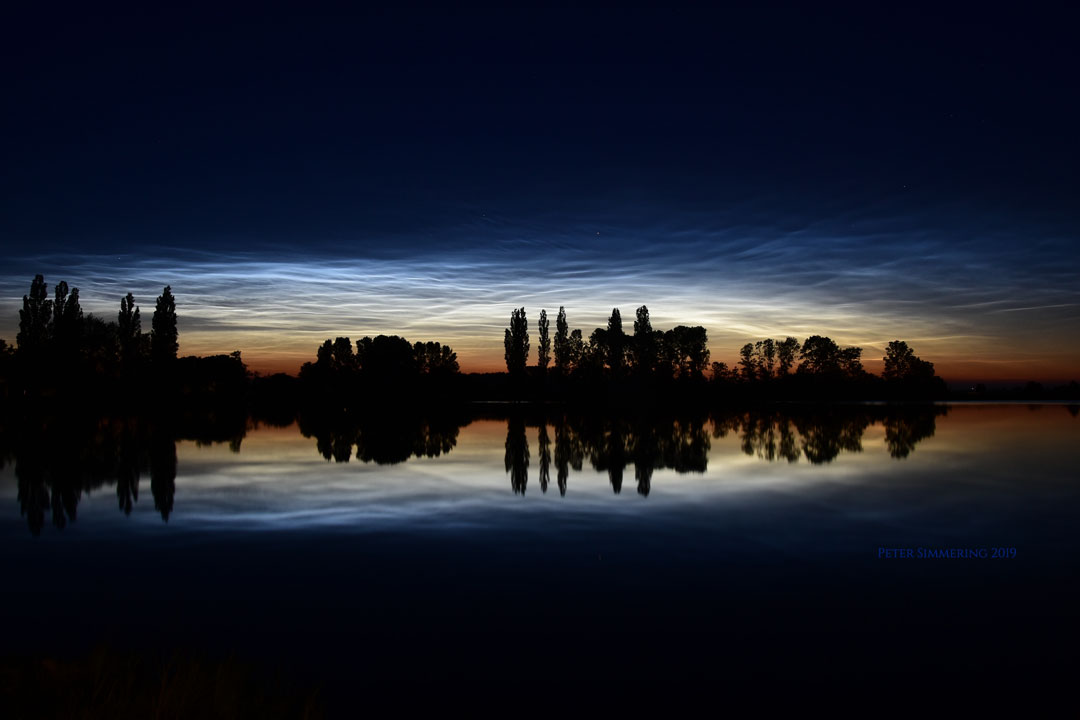
Noctilucent Clouds, Reflections, and Silhouettes
Sometimes it's night on the ground but day in the air. As the Earth rotates to eclipse the Sun, sunset rises up from the ground. Therefore, at sunset on the ground, sunlight still shines on clouds above. Under usual circumstances, a pretty sunset might be visible, but unusual noctilucent clouds float so high up they can be seen well after dark. Normally too dim to be seen, they may become visible just after sunset during the summer when illuminated by sunlight from below. Noctilucent clouds are the highest clouds known and thought to be part of polar mesospheric clouds. Featured here as they appeared two weeks ago, a network of noctilucent clouds was captured not only in the distant sky but in reflection from a small lake just north of Zwolle, Netherlands, with trees in stark silhouette across the horizon. Unusually bright noctilucent clouds continue to appear over much of northern Europe. Much about noctilucent clouds has been discovered only over the past decade, while how they form and evolve remains a topic of active research. Gallery: Recent noctilucent clouds over Europe
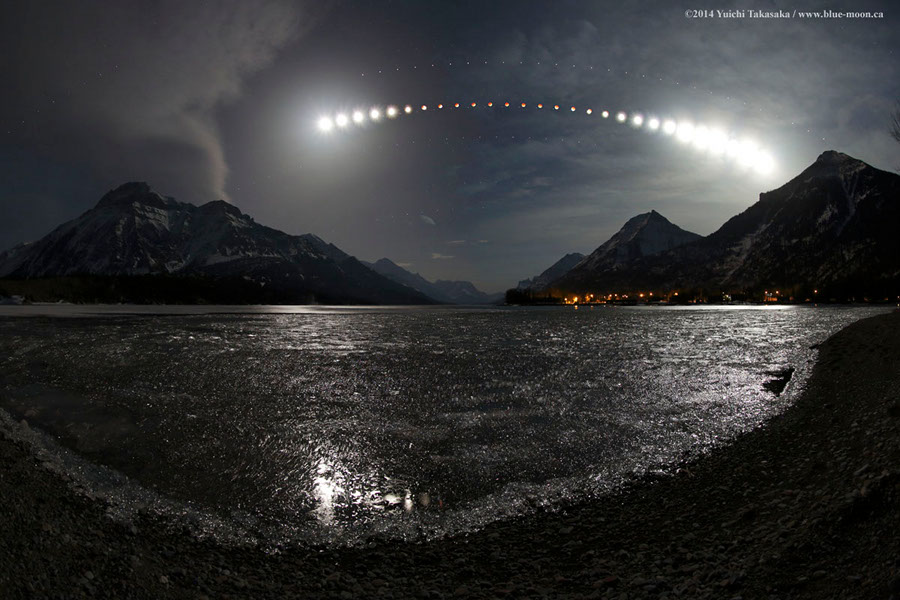
Waterton Lake Eclipse
Recorded on April 15th, this total lunar eclipse sequence looks south down icy Waterton Lake from the Waterton Lakes National Park in Alberta, Canada, planet Earth. The most distant horizon includes peaks in Glacier National Park, USA. An exposure every 10 minutes captured the Moon's position and eclipse phase, as it arced, left to right, above the rugged skyline and Waterton town lights. In fact, the sequence effectively measures the roughly 80 minute duration of the total phase of the eclipse. Around 270 BC, the Greek astronomer Aristarchus also measured the duration of lunar eclipses - though probably without the benefit of digital clocks and cameras. Still, using geometry, he devised a simple and impressively accurate way to calculate the Moon's distance, in terms of the radius of planet Earth, from the eclipse duration. This modern eclipse sequence also tracks the successive positions of Mars, above and right of the Moon, bright star Spica next to the reddened lunar disk, and Saturn to the left and below.
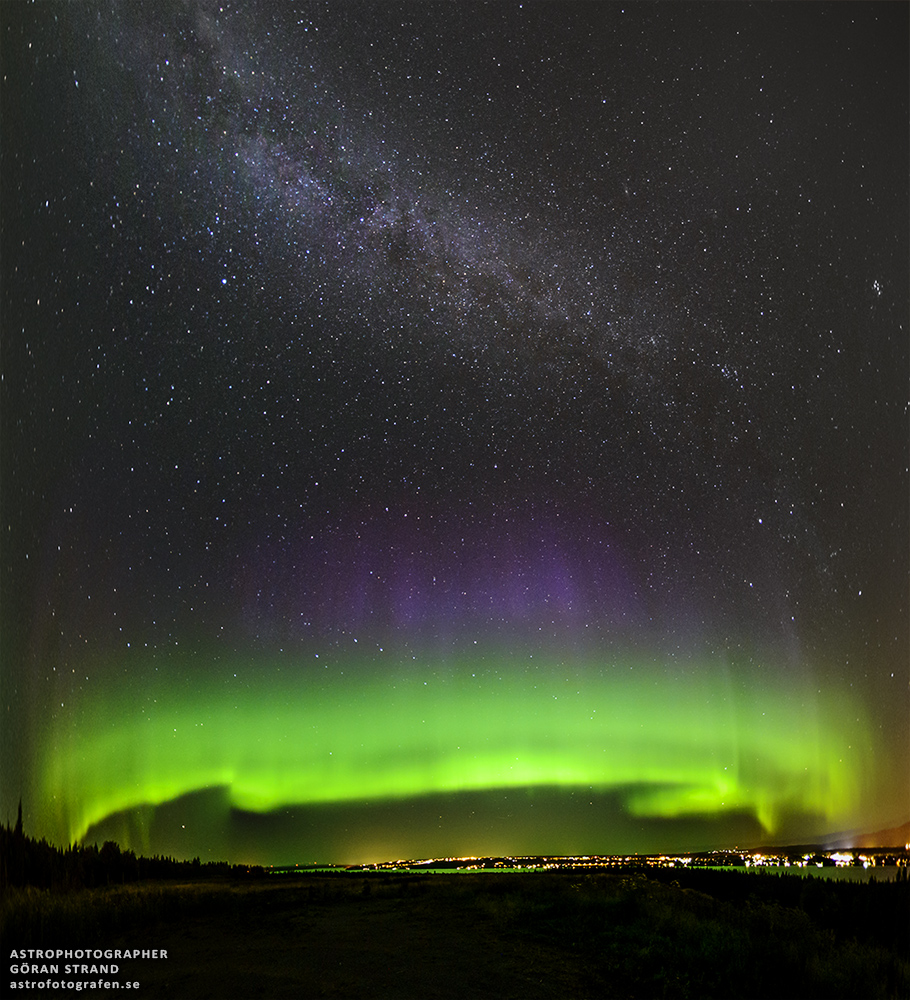
An Aurora Cupcake with a Milky Way Topping
This sky looked delicious. Double auroral ovals were captured above the town lights of �stersund, Sweden, last week. Pictured above, the green ovals occurred lower to the ground than violet aurora rays above, making the whole display look a bit like a cupcake. To top it off, far in the distance, the central band or our Milky Way Galaxy slants down from the upper left. The auroras were caused by our Sun ejecting plasma clouds into the Solar System just a few days before, ionized particles that subsequently impacted the magnetosphere of the Earth. Aurora displays may continue this week as an active sunspot group rotated into view just a few days ago.
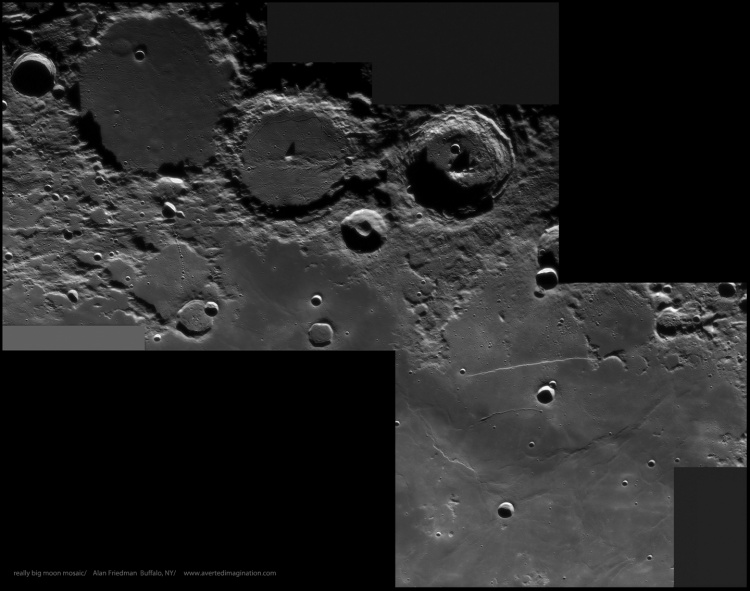
Ptolemaeus, Alphonsus and Arzachel
These three ancient, large impact craters lie on the north eastern shores of Mare Nubium, the lunar Sea of Clouds. Along the top of the stark mosaic (left to right) are the namesakes of Ptolemaeus, Alphonsus and Arzachel. The picture offers a remarkably detailed view of the well-studied region with shadows emphasizing the large crater central peaks and slumping walls. Careful examination also reveals the 110 kilometer long Straight Wall, a fault 200-300 meters high, and the intriguing Davy crater chain. Overall, the striking moonscape is similar to the final images recorded by the Ranger 9 spacecraft, before it crashed into the 108 kilometer wide crater Alphonsus in March of 1965.
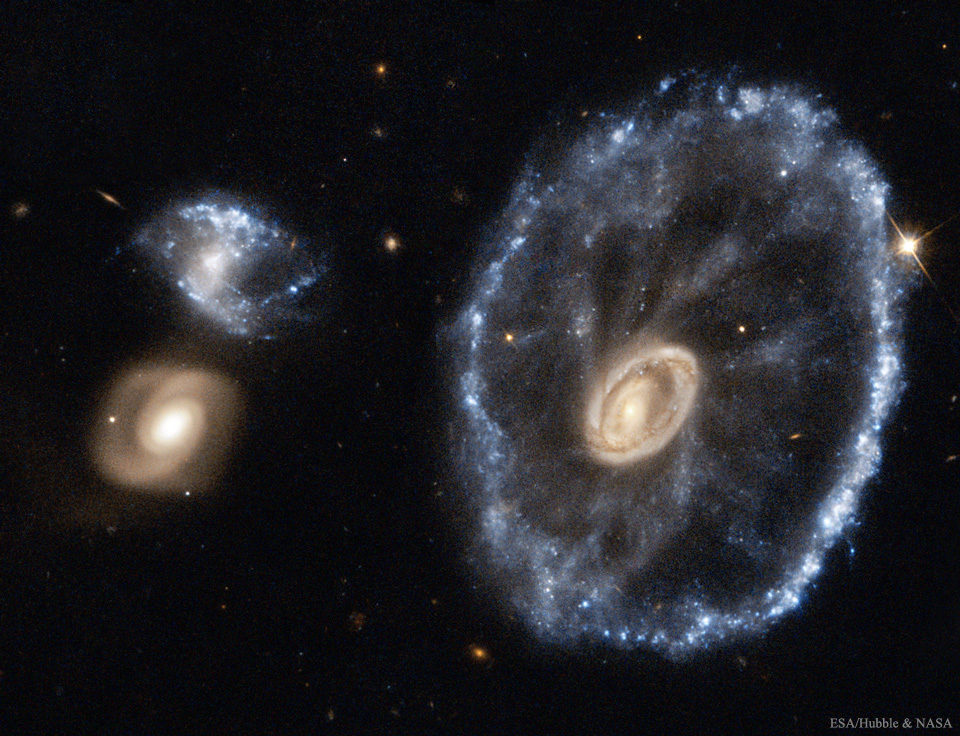
The Cartwheel Galaxy from Hubble
To some, it looks like the wheel of a cart. In fact, because of its outward oval appearance, the presence of a central galaxy, and their connection with what looks like the spokes of a wheel, the galaxy on the right is known as the Cartwheel Galaxy. To others, however, it looks like a complicated interaction between galaxies awaiting explanation. Along with the two galaxies on the left, the Cartwheel is part of a group of galaxies about 400 million light years away in the constellation Sculptor. The large galaxy's rim spans over 100,000 light years and is composed of star forming regions filled with extremely bright and massive stars. Pictured, the Cartwheel's ring-like shape is the result of gravitational disruption caused by a smaller galaxy passing through a large one, compressing the interstellar gas and dust and causing a star formation wave to move out like a ripple across the surface of a pond. Free Download: APOD 2017 Calendar: NASA Images
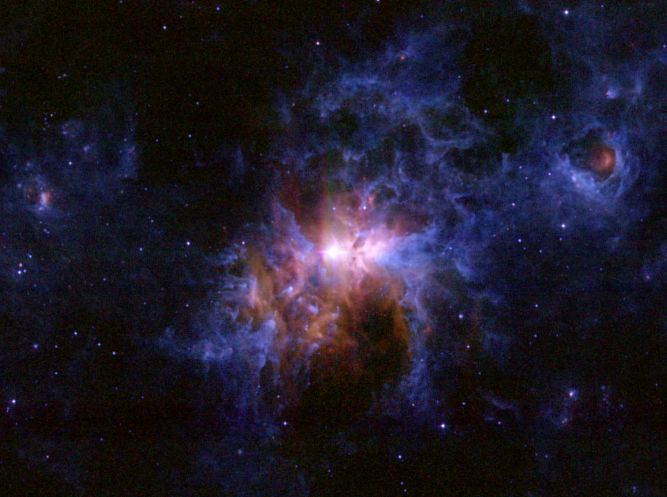
Dusty Environs of Eta Carinae
Car is a massive star, but it's not as bright as it used to be. Now only easily visible in binoculars or a small telescope, Eta Carinae has a history of spectacular flaring and fading behavior. In fact, in April of 1843 Eta Car briefly became second only to Sirius as the brightest star in planet Earth's night sky, even though at a distance of about 7,500 light-years, it is about 800 times farther away. Surrounded by a complex and evolving nebula, Eta Carinae is seen near the center of this false-color infrared image, constructed using data from the Midcourse Space Experiment (MSX). The MSX satellite mapped the galactic plane in 1996. In the picture, wispy, convoluted filaments are clouds of dust glowing at infrared wavelengths. Astronomers hypothesize that Eta Car itself will explode as a supernova in the next million years or so. Massive Eta Car has even been considered a candidate for a hypernova explosion and the potential source of a future gamma-ray burst.
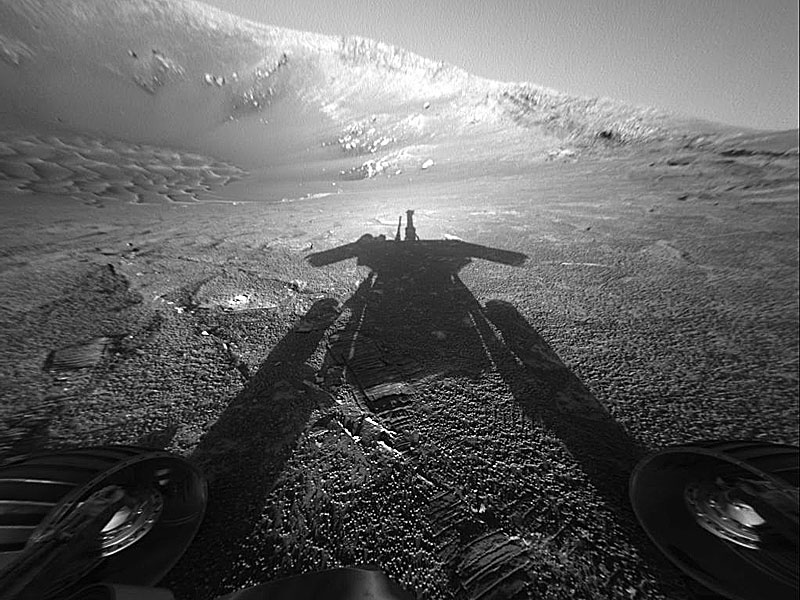
Shadow of a Martian Robot
What if you saw your shadow on Mars and it wasn't human? Then you might be the Opportunity rover currently exploring Mars. Opportunity and sister robot Spirit have been probing the red planet since early 2004, finding evidence of ancient water, and sending breathtaking images across the inner Solar System. Pictured above, Opportunity looks opposite the Sun into Endurance Crater and sees its own shadow. Two wheels are visible on the lower left and right, while the floor and walls of the unusual crater are visible in the background. Opportunity and Spirit have now spent over four years exploring the red world, find new clues into the wet ancient past of our Solar System's second most habitable planet.
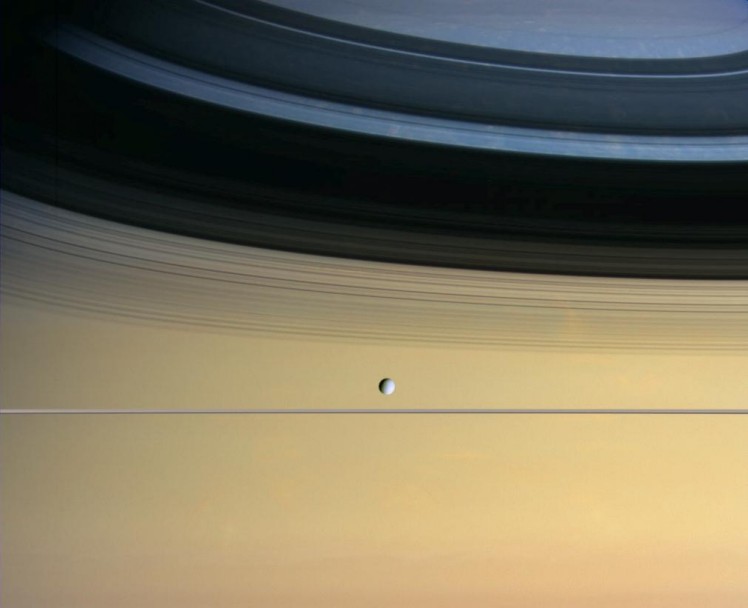
A Year at Saturn
Arriving at Saturn in July of 2004, the Cassini spacecraft has now spent a year and a half exploring the magnificent rings and moons of the distant gas giant. The year 2005 began with Cassini's Huygens probe landing on Saturn's large moon Titan. Cassini's continuing series of close flybys also revealed details and discoveries across the surface of the smog shrouded moon. In fact, with a ringside seat throughout 2005, Cassini's cameras have made spectacular pictures of Titan along with Saturn's other moons and rings almost common place. But often, Saturn itself provided the most dramatic backdrop. In this view, Saturn's moon Dione lies in front of edge-on rings and the gas giant's cloud tops draped with broad ring shadows. Dione is 1,118 kilometers across and lies about 300,000 kilometers from the ring's edge.
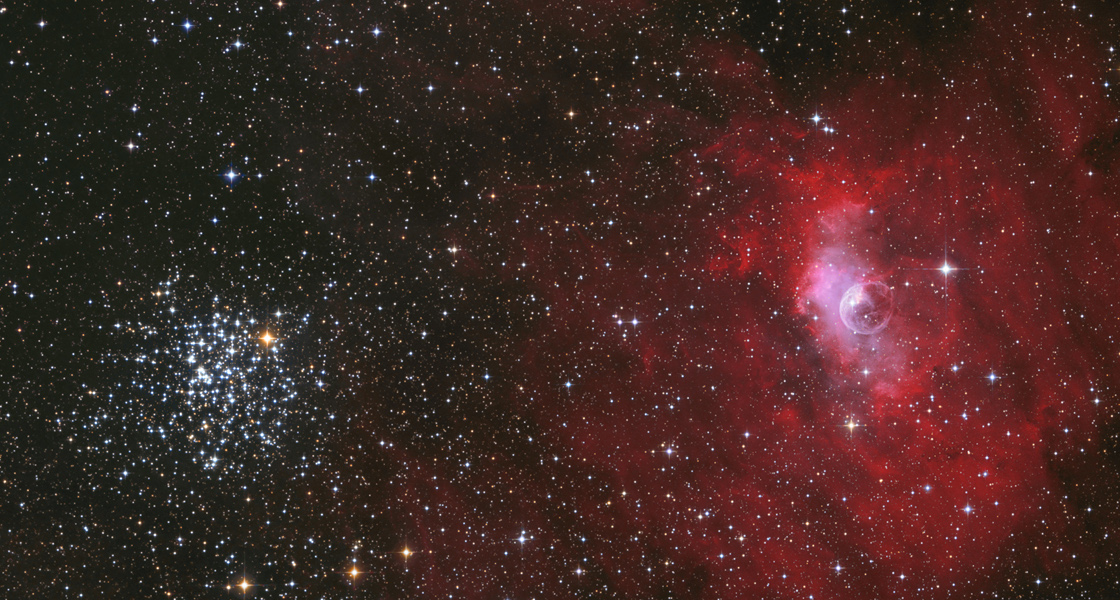
The Bubble and the Star Cluster
To the eye, this cosmic composition nicely balances the Bubble Nebula at the right with open star cluster M52. The pair would be lopsided on other scales, though. Embedded in a complex of interstellar dust and gas and blown by the winds from a single, massive O-type star, the Bubble Nebula, also known as NGC 7635, is a mere 10 light-years wide. On the other hand, M52 is a rich open cluster of around a thousand stars. The cluster is about 25 light-years across. Seen toward the northern boundary of Cassiopeia, distance estimates for the Bubble Nebula and associated cloud complex are around 11,000 light-years, while star cluster M52 lies nearly 5,000 light-years away. The wide telescopic field of view spans about 1.5 degrees on the sky or three times the apparent size of a full Moon.

Saharan Starry Night
This panoramic image of a starry night looks across a dry, desolate landscape. The magnificent view was recorded from Tassili National Park, in the heart of the Sahara desert in southern Algeria. Rising above eroded sandstone cliffs, the celestial menagerie of constellations includes Draco the Dragon, Cygnus the Swan, Aquila the Eagle, and Scorpius the Scorpion. Ruling planet Jupiter shines through clouds very close to the horizon near picture center, while star clouds of the Milky Way arc through Sagittarius above the rocks at the far right. Bright blue stars Deneb, in Cygnus, and Altair, in Aquila, also shine in the starry night along with Scorpius' bright yellowish star Antares, the rival of Mars. Prehistoric skygazers surely witnessed a similar sky. In addition to dramatic sandstone formations, the Tassili region is noted for rock art and archaeological sites dating to Neolithic times when the local climate was wetter.
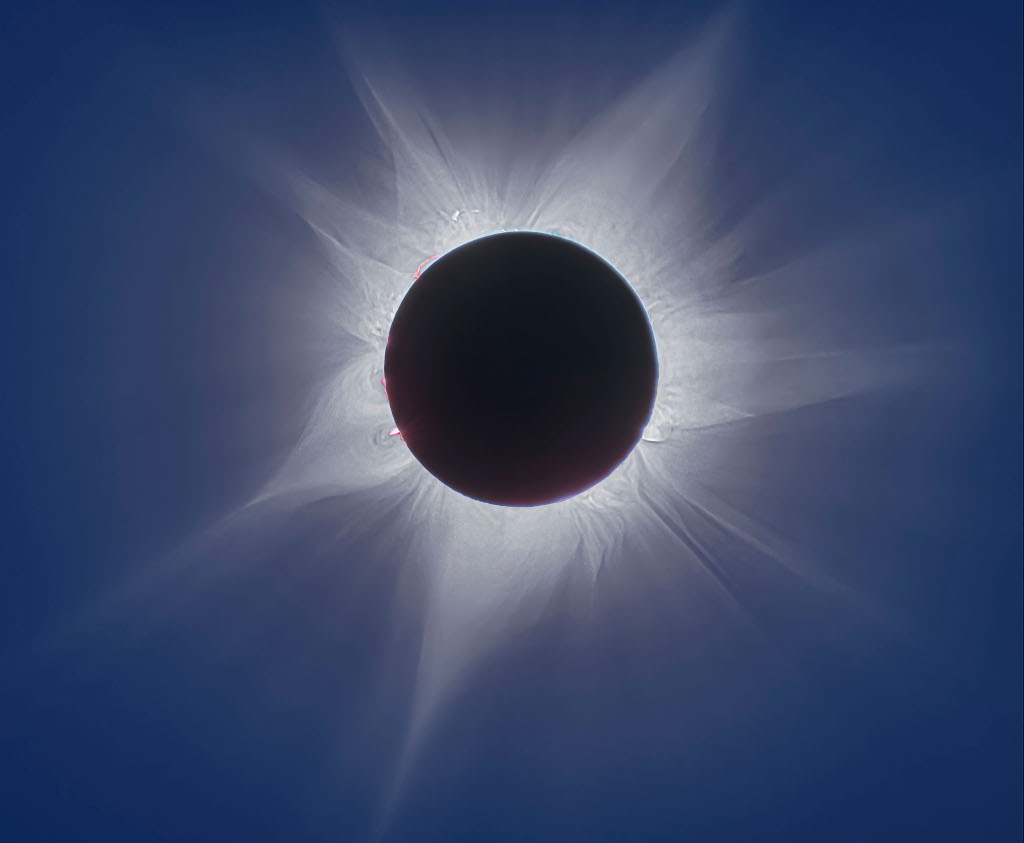
Solar Eclipse from a Ship
Along a narrow path that mostly avoided landfall, the shadow of the New Moon raced across planet Earth's southern hemisphere on April 20 to create a rare annular-total or hybrid solar eclipse. From the Indian Ocean off the coast of western Australia, ship-borne eclipse chasers were able to witness 62 seconds of totality though while anchored near the centerline of the total eclipse track. This ship-borne image of the eclipse captures the active Sun's magnificent outer atmosphere or solar corona streaming into space. A composite of 11 exposures ranging from 1/2000 to 1/2 second, it records an extended range of brightness to follow details of the corona not quite visible to the eye during the total eclipse phase. Of course eclipses tend to come in pairs. On May 5, the next Full Moon will just miss the dark inner part of Earth's shadow in a penumbral lunar eclipse. Total Solar Eclipse of 2023 April Gallery: Notable Submissions to APOD
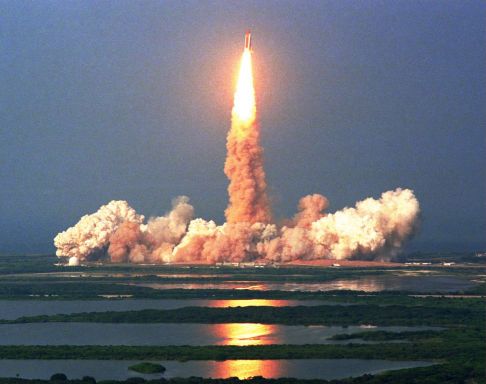
Happy 40th Birthday, NASA!
Happy Birthday, NASA! The National Aeronautics and Space Administration officially began operations on October 1, 1958, absorbing its forerunner organization the National Advisory Committee for Aeronautics, NACA. Its landmark achievements in human spaceflight include the Mercury and Gemini Projects culminating in the Apollo Project moon landings in the 1960s and early 1970s, Apollo-Soyuz and Skylab in the 1970s, and the Space Shuttle program of the 1980s and 1990s. (Pictured is the June 1998 launch of the Space Shuttle Discovery.) NASA's science programs have produced the robotic exploration of our Solar System, views of the Universe across the electromagnetic spectrum, and valuable meteorological and remote-sensing Earth observations. At birth, NASA's priorities were largely driven by the pressures and competitions of the Cold War. But looking back over 40 years, the sum of its accomplishments have produced needed new technologies and a vital new perspective on Planet Earth and the Cosmos.
4 Lezioni Gratuite su Come Utilizzare Il Telescopio
Telescopio spaziale Hubble e James Webb
Il telescopio spaziale Hubble, lanciato nel 1990, ha rivoluzionato il campo dell'astronomia, fornendo agli scienziati e al pubblico una visione senza precedenti dell'universo. Per oltre tre decenni, Hubble ha catturato immagini mozzafiato di galassie, nebulose e ammassi stellari, offrendo una comprensione più profonda della formazione e dell'evoluzione delle strutture cosmiche.
Nonostante il suo incredibile successo, il telescopio Hubble è destinato a essere superato dal telescopio spaziale James Webb, il suo successore high-tech. Lanciato nel 2021, il telescopio James Webb è dotato di uno specchio primario di 6,5 metri, molto più grande rispetto allo specchio di 2,4 metri di Hubble. Questo permette a James Webb di raccogliere molta più luce e osservare oggetti più deboli e distanti.
Inoltre, il telescopio spaziale James Webb è ottimizzato per l'osservazione nell'infrarosso, il che gli consente di penetrare nubi di gas e polvere che oscurano la vista di Hubble. Ciò significa che James Webb può svelare i segreti delle prime galassie formatesi dopo il Big Bang, studiare la formazione di stelle e pianeti e persino esaminare le atmosfere dei pianeti extrasolari alla ricerca di segni di vita.
Insieme, il telescopio spaziale Hubble e il telescopio spaziale James Webb rappresentano due delle più grandi conquiste dell'astronomia moderna. Grazie ai loro contributi, gli scienziati continueranno a esplorare e comprendere meglio l'universo che ci circonda.
×
![]()